1–3 properties
Small portfolio
£9.99 per month
Or £99 per year, paid upfront.
- Documents and version history
- Upcoming actions and reminders
- Remedial-work tracking
- Recorded tenant delivery evidence
- Dated evidence export
Coming this month · October 2026
Landlord compliance software for self-managing landlords with ordinary single-household lets in England. Documents, upcoming dates, repairs and tenant delivery records for each let, in one place.
Your 14 days begin when you redeem your invitation, not when you join. Joining creates no account and no billing. Plans at launch start from £9.99/month for 1–3 properties, or £99/year paid upfront.
Built around your day
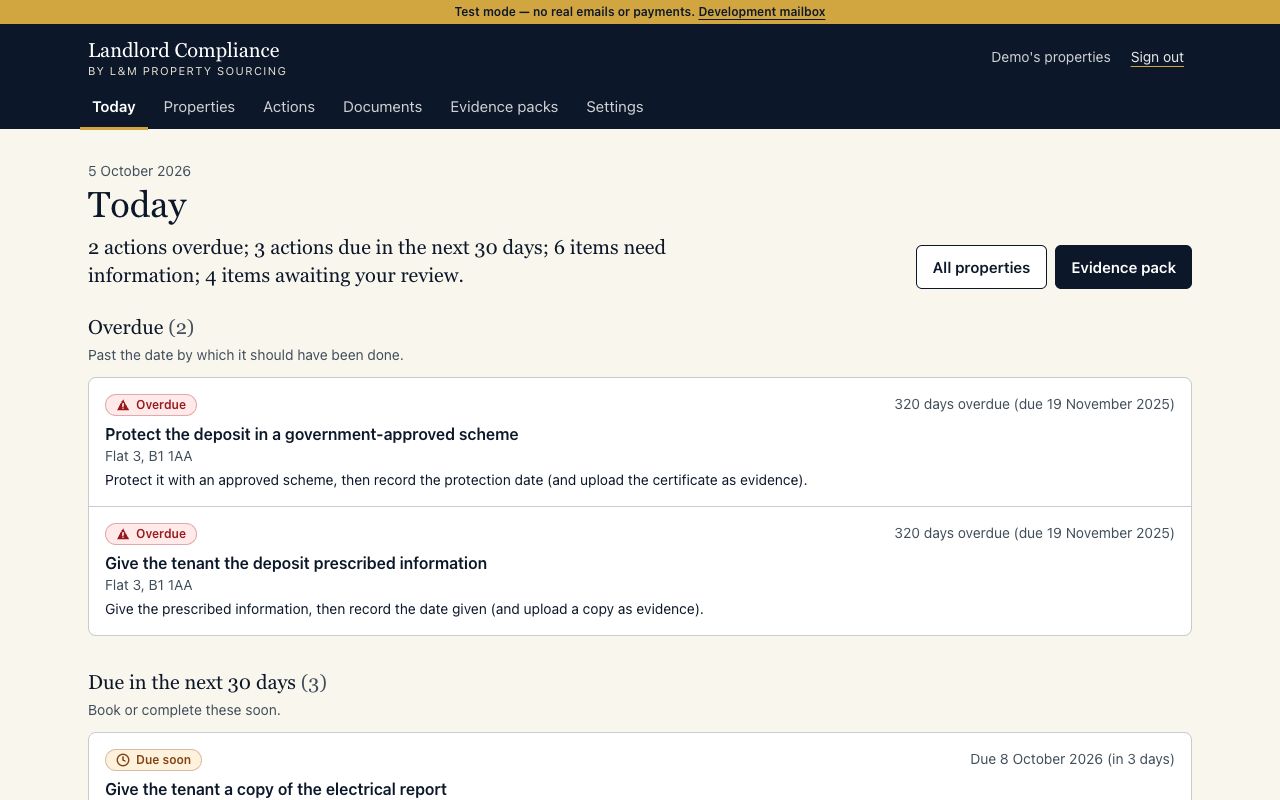
Real screens from the local development build, captured on 5 October 2026. Explore the records and actions before joining the launch list.
Today
A single view separates overdue actions, approaching dates and records needing your review. Start with the gaps rather than searching through folders.
Organises your records. It does not certify compliance or replace professional advice.
Open full-size today previewSee a fit for your lets? Explore the launch plans, then join the invitation list.
Compare the two launch plansDefinition
Landlord compliance software is a place to keep the records a landlord holds for each let, such as certificates, agreements, notices and repair records, together with the dates when something next needs attention and the evidence of what was done. L&M Landlord Compliance is a planned tool of this kind for self-managing landlords with ordinary single-household lets in England.
Each answer is a planned first-release feature.
Documents spread across email, folders and paper.
Each document is kept against its property. Earlier versions are kept, so you can see what was current on a given date.
Dates held in your head or an old calendar entry.
Upcoming actions across all your lets in one list, with reminders before the dates arrive.
Repairs with no clear record of how they ended.
The issue, the work arranged and the evidence that it was finished, kept together.
No easy way to show when a tenant received something.
A note of when and how you gave each document to a tenant, with the supporting record attached.
Gathering everything when someone asks what you hold.
A dated export of a property’s records.
Illustrative workflow · invented example
How the planned features fit together for one invented property. Not a screenshot or a record of real use.
The new gas safety record for Example Let A is uploaded. The earlier record stays in its version history.
Recorded: Document, version, date added
The date you note appears in one upcoming list across your lets, with a reminder before it arrives.
Recorded: Date, property, reminder
A tenant reports a noisy bathroom extractor fan. You log the issue and the work arranged, then attach the invoice and a photo when it is done.
Recorded: Issue, work arranged, completion evidence
You email the tenant a copy of the new record, then note how and when you gave it, with the sent email attached.
Recorded: Method, date, supporting record
When you need to show what you hold, you produce a dated export of the property’s records.
Recorded: Export date and contents
Planned for October 2026. Your 14 days begin when you redeem your invitation.

Behind every let, a set of records
A certificate in an inbox. A date in a calendar. A repair in a message thread. Bringing the records together makes it easier to see what you hold and what still needs attention.
Start with one property or organise up to ten. Both launch plans include the same core features.
Ask for your trial invitationFree practical guide
An original L&M guide for arranging what you already hold. Use it with folders, a spreadsheet or any tool. It is not a complete list of legal requirements and it is not legal advice: what applies depends on your let.
For what the law requires, start here
One folder or record per property, named the same way every time.Example: “Example Let A · 2-bed flat”, not “flat docs (new)”.
The tenancy agreement and any renewals, with the start date noted on the record.Example: Agreement, renewal letter, the date each began.
The people and services connected to the let.Example: Insurer, contractors you use, utility and council tax accounts.
Each certificate or report saved with its issue date and the date it next needs attention.Example: For example a gas safety record, an electrical installation condition report or an Energy Performance Certificate, where they apply.
Superseded versions kept, not overwritten.Example: Last year’s record moved to an “earlier versions” folder, not deleted.
Checks you carry out yourself, dated.Example: Alarm tests at the start of a tenancy, inspection notes.
A list of what you gave the tenant, how and when.Example: “How to Rent guide, emailed 2 October, sent email saved.”
Deposit paperwork, if you took a deposit.Example: The protection confirmation and the information you gave the tenant.
Records of the checks you made before the tenancy.Example: For example right to rent check records, where they apply.
Each repair request with the date reported, the work arranged and evidence it was finished.Example: Tenant’s message, contractor booking, invoice, dated photo.
Inspection notes and photographs, dated.Example: A short note per visit, saved against the property.
Correspondence that changes anything, saved against the property.Example: Agreed access dates, rent changes, notices.
One list of what next needs attention, across every let.Example: Sorted by date, reviewed on a set day each month.
A habit of filing on the day something arrives.Example: New certificate in, old one to earlier versions, date updated.
The ability to produce a dated summary of what you hold.Example: A list or export you can send to your own adviser.
Having a record is not the same as being able to show it reached the tenant. Keeping all three together makes the gaps easier to see.
What do I have?
What you hold.
A certificate, an agreement, a report or a notice.
Example: The current gas safety record for Example Let A.
What is next?
When something next needs attention.
A renewal, a planned inspection or a follow-up you have promised.
Example: The inspection you have planned for early November.
Can I show it was done?
Proof that something happened.
A sent email, a signed receipt, an invoice or a dated photo.
Example: The email showing the tenant was sent a copy, and the invoice for the finished repair.
Coming this month · October 2026
Choose by the number of properties you manage. Both plans include the same core features at launch, with no setup fee.
1–3 properties
£9.99 per month
Or £99 per year, paid upfront.
4–10 properties
£14.99 per month
Or £149 per year, paid upfront.
Prices shown are total prices. Your free 14-day trial starts when you redeem your invitation. No card is needed during the trial; you choose a paid plan afterwards and will not be charged automatically. Joining the launch list creates no account and no billing.
For self-managing landlords with ordinary single-household lets in England. More than ten properties: no paid plan is offered at launch; we confirm scope and capacity before an invitation.
Initial focus
2 to 10 lets. The first release is built around portfolios of this size.
One let, or more than ten
You can still join. We will confirm the first release’s limits for your portfolio size before we send an invitation.
Outside the first release
The form tells you straight away. You will not be added to the trial list, but you can ask us to tell you if that changes.
A fair comparison
Many landlords manage well with a spreadsheet and a calendar. This compares how each handles the same jobs. It describes the planned first release and does not claim that any option makes you compliant.
| Job | Spreadsheet and folders | Shared calendar | L&M Landlord Compliance (planned first release) |
|---|---|---|---|
| Where documents are kept | In folders you set up, linked from cells if you choose | Not designed to hold documents; some calendars allow attachments | Against each property |
| Earlier versions | Kept if you save copies yourself | Not applicable | Earlier versions kept |
| Upcoming dates and reminders | Dates in cells; reminders need a separate set-up | Reminders are its main purpose | One upcoming list across your lets, with reminders |
| Repairs and their evidence | Possible with your own columns and links | Not designed for it | Issue, work and completion evidence kept together |
| Tenant delivery records | Possible as a column you maintain | Not designed for it | When and how, with the supporting record attached |
| Showing what you hold | Print or export what you have built | Not designed for it | Dated export of a property’s records |
| Structure | Flexible: you design it and keep it consistent | Quick for dates alone | A set structure for the first release’s scope |
| Cost | Usually software you already have | Usually already available | At launch: £9.99/month for 1–3 properties; £14.99/month for 4–10. Annual options £99 or £149, paid upfront. |
When a spreadsheet may be enough: one or two lets, few documents, and a routine you already keep up. The checklist above works with it.
Coming this month · October 2026
Coming this month · October 2026
Four short answers tell us whether the first release fits your lets. If it does not, the form says so before you send anything.
What happens next
We do not ask for
Property addresses, tenant details, documents or payment details.
We will email you about the launch invitation only. Other updates are a separate, optional choice, unticked by default.
We plan to send launch invitations in October 2026. If that date moves, everyone on the launch list will hear from us first.
When you redeem your launch invitation, not when you join the list. Joining the list does not start a trial, create an account or set up billing.
At launch: £9.99 a month for 1–3 properties, or £99 a year paid upfront; £14.99 a month for 4–10 properties, or £149 a year paid upfront. Both include the same core features. These are total prices, with no setup fee. No card is needed for the 14-day trial; you choose a paid plan afterwards and will not be charged automatically. Joining the list does not commit you to anything.
No tool can do that on its own. It keeps your records, dates and evidence together so you can see what needs doing. Decisions about your obligations remain yours, with professional advice where needed.
No. It organises the records and dates you hold. It does not decide which legal requirements apply to a let. GOV.UK sets out landlord responsibilities, and a solicitor or other qualified adviser can advise on your situation.
No. It is a record-keeping tool for landlords who manage their own lets. It does not act on your behalf or give advice, and the first release is not designed for agent-managed lets.
Not for the first release. You can ask us to tell you if it later supports your situation; you will not be added to the trial launch list.
Yes. The first release is built around portfolios of 2 to 10 lets, so we will confirm its limits for your portfolio size before we send an invitation.
An ordinary single-household let in England is within the first release, whether or not a council licensing scheme applies to it. The tool does not decide whether a licence is needed or what a licence requires. Your council can tell you that.
Yes. The record-organisation checklist is free to use with folders, a spreadsheet or anything else. It is a practical guide, not a complete list of legal requirements.
Your name, email address and four short answers about your lets. We do not ask for property addresses, tenant details or documents.
Prepared and reviewed by L&M Property Sourcing Ltd on . Product descriptions reflect the planned first release and may change before launch; this page will be updated if they do. The checklist and comparison are L&M’s own practical guidance, not legal advice and not a complete legal checklist.